We found 74 result(s) for your search on “@filter”
Tags

In Breda, a lot is already happening in the field of youth participation. However, in practice it turned out that initiatives often exist separately from each other. The Democracy Reloading trajectory gave the municipality the opportunity to gain better insight into this. Youth Project Leader Miriam Rijvers describes the trajectory as a journey of discovery that led to new insights, more connection, and a compass for the future.

The search

What started as an ambition to make youth participation visible grew into a journey of discovery. “Along the way, it became clear that separate initiatives within the organisation are not enough,” Miriam explains. “The exploration of existing initiatives at the start of the trajectory showed that there was fragmentation: projects without cohesion between domains and departments. There was a lack of overarching direction, which made collaboration and support difficult to achieve.”

“I also saw that much policy is still being developed without directly involving young people. Not because colleagues do not want to, but because it is often unclear where to begin. Sometimes a network partner is asked to present something to young people, but without follow-up this quickly fades and young people drop out. This creates distance, while we are actually striving for sustainable connection.”

From doubt to insight

Halfway through the trajectory, doubts arose. “I asked myself: where is this going? What will this ultimately deliver? It was precisely this uncertainty that created space for new ideas. We realised that change does not start with writing plans, but with asking questions. By opening up the conversation, space for collaboration and innovation emerged.”

“The coaching sessions within Democracy Reloading helped me and the colleagues involved to create focus. This led to municipality-wide creative working sessions and conversations with employees from different domains. By asking what teams need and which elements in their current way of working are already effective, energy and new connections emerged.”

Key insights

Three guiding insights emerged from the working sessions:

Ownership is crucial

“Truly involving young people only works if someone takes responsibility for the process and safeguards the connection. Without ownership, youth participation gets stuck in isolated actions. That responsibility can lie with a youth participation coordinator, who brings together young people, internal departments, and partners. Ideally, a young person fulfils this role themselves, so that their perspective leads and the collaboration remains authentic.”

Knowledge sharing strengthens collaboration

“A central place for knowledge sharing is indispensable. A knowledge base in which experiences, tools, and inspiring examples come together stimulates learning and collaboration, both within the organisation and with partners.”

Connection is the key to impact

“Separate initiatives do not work. By connecting departments and areas of expertise, coherence emerges, space for joint learning processes is created, and knowledge is used more effectively. In this way, initiatives better align with the complexity of societal issues.”

Lessons learned

“The trajectory showed me that change takes time and starts with an open attitude. Not by imposing plans, but by listening, asking questions, and facilitating. It requires a process in which there is room for dialogue and collaboration.” Creative working sessions and the use of imagery proved to be powerful tools to make abstract ideas concrete and to jointly give direction. “By imagining and experimenting together, energy is created and a shared understanding of what is possible emerges.”

The trajectory showed that youth participation does not arise automatically. It requires conscious choices and a culture in which the perspective of young people is taken seriously.

Досега 20 общини са участвали в инициативата „Презареждане на Демокрацията“ – съвместен проект на Нидерландския младежки институт (NJi) и програма „Еразъм+“. В рамките на този процес те проучиха как младите хора могат да играят активна роля при вземането на решения на общинско ниво, какво е необходимо за това и как този подход може да бъде устойчиво утвърден. Те споделят своя опит, прозрения и ключови поуки.

Какво искаха да научат общините за участието на младежите?

Много общини започнаха процеса „Презареждане на Демокрацията“, водени от споделеното разбиране за важността на участието на младежите, но и с въпроси относно това как да му придадат конкретна форма. Още в самото начало стана ясно, че често липсва цялостен поглед върху ситуацията: в някои общини вече се случваха много неща, но без необходимата последователност и координация, докато в други активността беше по-слаба от очакваното. Извършеният анализ даде на общините по-добра представа за текущото състояние и за възможностите, които все още не бяха използвани. Това спомогна за по-целенасоченото планиране на техния подход.

Практически пример: община Бреда

„Беше полезно първо да получим добър преглед на това, което вече се случва, за да можем да предприемем целенасочена стъпка.“

Как печелите подкрепата на колегите и организацията си за участието на младежите?

Макар много служители да осъзнават значението на участието на младежите, мненията относно практическото му прилагане се различават. В някои общини съществува ясен мандат от общинския съвет, но това не води автоматично до широко ангажиране в рамките на организацията.

Нивото на подкрепа и ангажираност варира в зависимост от отдела или конкретния служител. Поради това общините подчертават, че участието на младежите не бива да се налага, а изисква насърчаване и демонстриране на добавената му стойност.

„Трябва непрекъснато да се показва какви резултати носи то, в противен случай лесно остава на заден план.“
Експерт по политиките в социалната сфера, община Лелистад

За да повишат ангажираността в рамките на организацията, общините описват различни подходи:

  • Повишаване на видимостта чрез редовно насочване на вниманието към участието на младите хора – например във вътрешнофирменото списание, по време на редовни срещи или в неформални разговори (например до кафе-машината).
  • Организиране на работни сесии, в които служителите си сътрудничат. Тези сесии често привличат ентусиазирани служители, които могат да действат като посланици на инициативата в рамките на организацията.
  • Осигуряване на ясна отговорност чрез определяне на лице за контакт по въпросите на участието на младите хора, което да отговаря на въпроси и да оказва подкрепа на колегите.
  • Активно общуване с колегите с цел обсъждане на възражения, съмнения и мотивация.

Освен това, в хода на процеса бяха разработени инструменти, които да подпомогнат вътрешните разговори в организацията и да повишат осъзнатостта на колегите относно тяхната роля. Например, община Тилбург описва как наръчникът за участие на младежите помага за осмисляне на причините и начините за такова участие. Част от него е „огледало на псевдоучастието“ – инструмент, който подтиква хората, вземащи решения, да подложат собствените си проекти на критичен анализ.

„То помага на колегите да се замислят над въпроса: дали идеята идва от самите млади хора, или е нещо, което ние им налагаме?“
Програмен секретар „Жива демократия“, община Тилбург

Кога и защо включвате млади хора?

В хода на процеса стана ясно, че е полезно още в началото съзнателно да се обмисли въпросът дали и как да бъдат включени младите хора, както и с каква цел. Предварителното изясняване на тези аспекти помага да се разбере по-добре какво се цели с участието на младежите и предотвратява превръщането му в изолирана, самоцелна дейност.

„Най-големият риск е участието на младежите да се превърне в отмятане на точки от списък. Така може да се каже, че е направено нещо, но това не говори нищо за реално участие.“
Експерт по политиките в социалната сфера, община Лелистад

Когато липсва такава насока, се оказва трудно и пълноценното ангажиране на младите хора.

„Ако самият ти нямаш яснота какво искаш, не знаеш и какво изискваш от младите хора – и тогава отговорът липсва.“
Съветник по родителство и възпитание, община Хуксе Вард

За да взема по-осъзнати решения в това отношение, община Вифхееренланден разработи инструмент за своите служители.

„Създадох дърво на решенията, което колегите могат да използват в началото на даден проект. То започва с въпроса: искате ли да включите млади хора, а ако да – коя целева група и с каква цел?“
Съветник по младежка политика, община Файфхеренланден

Как достигате до младите хора и ги привличате за участие?

На практика се оказва, че достигането до широка и разнородна група млади хора не е лесна задача. Често не е ясно къде се намират младежите и кой е най-добрият начин за контакт с тях.

В хода на процеса общините проучиха различни начини за достигане до младите хора. Например, на моменти се прилагаха подходи, насочени към широка аудитория и осигуряващи лесен достъп до инициативата.

„Свързахме се с 4000 млади хора чрез картичка с QR код, за да ги поканим да споделят идеи за облика на средата, в която живеят. Откликнаха 1000 младежи.“
Ръководител на младежки проект, община Бреда

Други общини предпочетоха активно да търсят млади хора, например чрез съществуващи мрежи и ключови фигури.

„Познавам редица млади хора, с които се свързах лично. Търсехме млади хора и чрез ключови фигури. Започвам с една ключова фигура и след това питам: с кого трябва да разговарям следващия път? По този начин мрежата продължава да се разраства.“
Съветник по родителство и възпитание, община Хуксе Вард

Освен това, предпочитанията на младите хора относно темите, които ги привличат, и начина, по който искат да допринесат, са различни.

„Някои предпочитат просто да видят листовка, докато други биха предпочели видео с кмета, плакати или информация в социалните мрежи. И защо да не им позволим сами да решат как искат да се включат в тези теми?“
Служител, отговарящ за участието на младежите, община Емен

Невинаги е очевидно коя форма на младежко участие е най-подходяща. Това изисква проучване и експериментиране, както и съобразяване с предпочитанията на самите млади хора.

Освен това се оказва, че една-единствена фиксирана форма – например младежки съвет – често достига само до определена група млади хора. Участващите младежи обикновено вече са мотивирани или проявяват интерес, докато други групи остават извън обхвата на инициативата. Чрез съчетаване на различни форми на участие общините достигат до по-широка и по-разнообразна група млади хора.

Как гарантирате, че младите хора остават ангажирани?

Според участващите общини участието на младежите става по-устойчиво, когато се работи целенасочено и внимателно по него. Това не означава, че всичко върви гладко от самото начало, а по-скоро, че:

  • инвестира се в личен контакт с младите хора
  • младите хора биват питани не само за мнението си, но и по какъв начин биха искали да го изразят
  • предварително се представя реалистична картина на рамките, в които се осъществява участието на младите хора – например какво вече е решено и къде все още има възможност за оказване на влияние
  • младите хора получават обратна връзка относно това какво е предприето въз основа на техните предложения, дори и (към момента) да не е предприето нищо

Ако тези елементи липсват, е по-трудно да се поддържа ангажираността на младите хора. Практически фактори като времето, училището и необходимите усилия също играят роля. Освен това устойчивото участие на младежите изисква непрекъснато привличане на нови млади хора – например чрез широкообхватен подход и като им се даде възможност сами да преценят как биха искали да се осъществява контактът с тях.

Пет важни аспекта за общини, които тепърва започват с участието на младежите

От този процес се открояват няколко важни аспекта, които помагат на общините да насочат по-целенасочено участието на младежите.

  • Поглед към настоящата практика. Общините отбелязват, че е полезно първо да се направи преглед на това как изглежда участието на младежите на местно ниво.
  • Критичен поглед върху подхода. Полезно е настоящата практика да се разгледа критично, например чрез инструменти като „стълбицата на участието“. Това позволява да се види къде участието вече функционира добре и къде има възможности за неговото укрепване или по-добро интегриране в работата на институцията.
  • Достигане до различни групи младежи. Анализът на това до кои младежи вече се достига и кои групи остават извън полезрението, помага за по-целенасочена и приобщаваща работа.
  • Връзка с процесите на вземане на решения. Участието на младежите придобива по-голяма стойност, когато е обвързано с моменти, в които реално се вземат решения – например при стартирането на нови политики или в рамките на работни групи.
  • Непрекъснато учене и развитие. Общините посочват, че използването на примери, инструменти и конкретни насоки помага за поетапното развитие на младежкото участие.

„Най-важният урок, който научих, е, че просто трябва да започнеш! Просто трябва да продължиш напред, да действаш и да се учиш – а впоследствие можеш просто да коригираш процеса си.“
Програмен секретар „Жива демократия“, община Тилбург

So far, 20 municipalities have participated in the Democracy Reloading trajectory, a collaboration between the Netherlands Youth Institute (NJi) and Erasmus+. During this trajectory, they explored how young people can play an active role in municipal decision-making, what is needed for this, and how this can be sustainably embedded. They share their experiences, insights, and key lessons.

What did municipalities want to learn about youth participation?

Many municipalities started the Democracy Reloading trajectory from a shared awareness of the importance of youth participation, but with questions about how to give this concrete form. Already at the beginning, it became clear that an overview was often lacking: in some municipalities, a lot was already happening, but without coherence, while in other municipalities, less was happening than expected. An analysis gave municipalities better insight into what was already happening and where opportunities still lay. This helped to give more direction to their approach.

Practical example municipality of Breda

“It was helpful to first get a good overview of what is already happening, so that we could take a targeted step.”

How do you get your colleagues and organisation on board with youth participation?

Although many employees recognise the importance of youth participation, views differ on the practical implementation. In some municipalities, there is a clear mandate from the municipal council, but this does not automatically lead to broad involvement within the organisation.

Support and commitment vary per department or employee. Therefore, municipalities emphasise that youth participation should not be imposed, but requires facilitation and making its added value visible.

“You have to keep showing what it delivers, otherwise it easily fades into the background.”
Policy advisor social domain, municipality of Lelystad

To increase involvement within the organisation, municipalities describe different approaches:

  • Increasing visibility by regularly bringing youth participation to attention, for example in the staff magazine, during regular meetings, or at the coffee machine.
  • Organising working sessions in which employees work together. These sessions often attract enthusiastic employees, who can act as ambassadors within the organisation.
  • Ensuring clear ownership, with a contact person for youth participation who answers questions and supports colleagues.
  • Actively engaging in conversation with colleagues to explore objections, doubts, and motivation.

In addition, tools were also developed during the trajectory to support conversations within the organisation and to make colleagues more aware of their role. For example, the municipality of Tilburg describes how a handbook for youth participation helps to reflect on the why and how of participation. Part of this is a “pseudo-participation mirror”: a tool that invites policymakers to critically examine their own projects.

“It helps colleagues reflect on the question: does the idea come from young people themselves, or is it something we impose on them?”
Programme secretary Lively Democracy, municipality of Tilburg

When and why do you involve young people?

During the trajectory, it became clear that it helps to consciously reflect at the beginning on the question of whether and how to involve young people, and with what purpose. By clarifying this in advance, it becomes clearer what you want to achieve with youth participation and prevents it from becoming a standalone activity.

“The biggest risk is that youth participation becomes a checklist. Then you can say you have done something, but it says nothing about real participation.”
Policy advisor social domain, municipality of Lelystad

If that direction is lacking, it also proves difficult to involve young people properly.

“If you yourself are not clear about what you want, you also don’t know what you are asking of young people, and then responses fail to come.”
Advisor parenting and upbringing, municipality of Hoeksche Waard

To make more conscious choices in this, the municipality of Vijfheerenlanden developed a tool for colleagues.

“I developed a decision tree that colleagues can use at the start of a project. It begins with the question: do you want to involve young people, and if so, which target group and with what goal?”
Youth policy advisor, municipality of Vijfheerenlanden

How do you reach and involve young people?

Reaching a broad and diverse group of young people proves in practice not to be self-evident. Often it is not clear where young people are and how they can best be approached.

During the trajectory, municipalities explored different ways to reach young people. For example, young people were sometimes approached broadly and in a low-threshold way.

“We approached 4000 young people with a card containing a QR code to contribute ideas about the design of their living environment. 1000 young people responded.”
Youth project leader, municipality of Breda

Other municipalities chose instead to actively seek out young people, for example through existing networks and key figures.

“I know a number of young people whom I approached personally. We also looked for young people through key figures. I start with one key figure and then ask: who should I speak to next time? In this way, the network keeps expanding further.”
Advisor parenting and upbringing, municipality of Hoeksche Waard

In addition, it differs per young person which topics appeal to them and in what way they want to contribute.

“One prefers to just see a flyer and another a video with the mayor or posters or social media. And why wouldn’t we just let them have a say in how they want to be involved in those topics?”
Youth participation staff member, municipality of Emmen

It is not always obvious which form of youth participation fits best. This requires exploration and experimentation, and aligning with what young people themselves prefer.

In addition, it appears that one fixed form, such as a youth council, often only reaches a specific group of young people. Young people who participate are often already motivated or interested, while other groups remain out of sight. By combining different forms of participation, municipalities reach a broader and more diverse group of young people.

How do you ensure that young people stay involved?

According to participating municipalities, youth participation becomes more sustainable when this is worked on carefully. This does not mean that everything goes well at once, but rather that:

  • investment is made in personal contact with young people
  • young people are not only asked for their opinion, but also how they want to give it
  • young people are given a realistic picture in advance of the frameworks within which their input takes place, such as what has already been decided and where there is still room for influence
  • young people receive feedback on what has been done with their input, even if (as yet) nothing is done with it

If these elements are missing, it is more difficult to keep young people involved. Practical factors, such as time, school, and the required effort, also play a role. In addition, sustainable youth participation requires continuing to involve new young people, for example by approaching them broadly and letting them think about how they want to be reached.

Five points of attention for municipalities that are just starting with youth participation

Several points of attention emerge from the trajectory that help municipalities to shape youth participation in a more targeted way.

  • Insight into the current practice. Municipalities indicate that it helps to first map out what youth participation looks like within the municipality.
  • Critical view of the approach. It helps to critically examine current practice, for example using tools such as the participation ladder. This makes visible where participation already works well and where there is still room to strengthen or better embed participation in the organisation.
  • Reaching different groups of young people. Mapping which young people are already being reached and which groups remain structurally out of sight helps to work more targeted and be more inclusive.
  • Link to existing decision-making. Youth participation gains more meaning when it is connected to moments where actual decisions are made, for example at the start of policy or within working groups.
  • Continuing to learn and develop. Municipalities indicate that it helps to make use of examples, tools, and concrete guidelines to further develop youth participation step by step.

“The biggest lesson I have learned is that you just have to start doing it! You just have to keep going, you just have to do it, and learn, and you can simply adjust your process.”
Programme secretary Lively Democracy, municipality of Tilburg

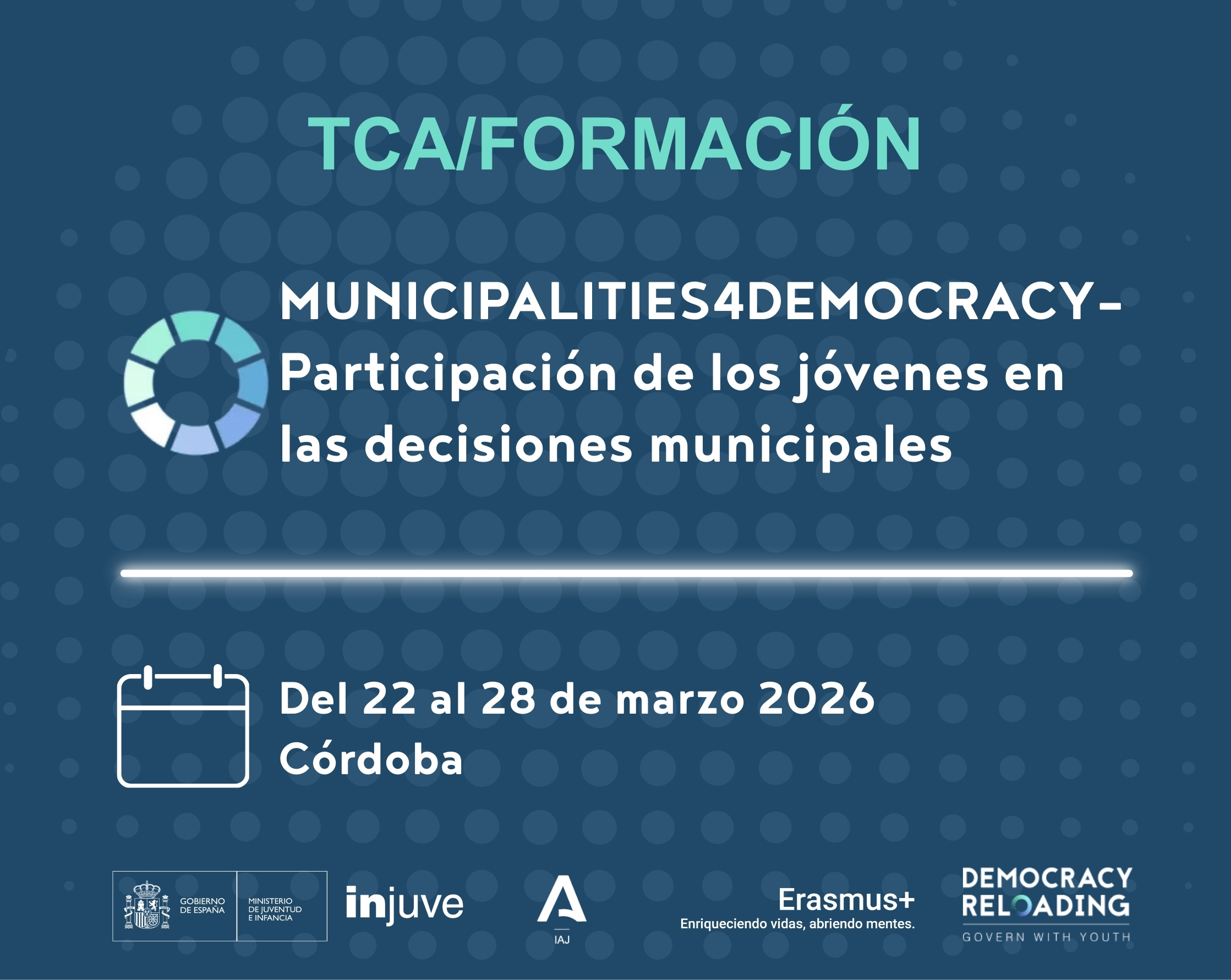
TCA Municipalities4Democracy - Participación de los jóvenes en las decisiones municipales 


El Instituto de la Juventud junto con la Dirección Provincial de Córdoba del Instituto Andaluz de la Juventud organizó la formación Municipalities4Democracy - Participación de los jóvenes en las decisiones municipales. Esta formación, que se impartió en castellano, consistió en un módulo de capacitación de 6 días dirigido a técnicos municipales y decisores políticos (concejales de juventud, tenientes de alcalde o incluso alcaldes y representantes de consejos municipales de juventud…) que desarrollan su trabajo en el ámbito de las políticas de juventud.


El principal objetivo de esta iniciativa fue ofrecer una formación práctica y especializada para que los participantes pudieran diseñar e implementar mecanismos eficaces de participación juvenil en la toma de decisiones a nivel municipal.


La formación abordó herramientas, metodologías y experiencias para promover una mayor implicación de las personas jóvenes en los procesos de decisión que les afectan, fortaleciendo así la democracia local.


La Estrategia Democracy Reloading ha diseñado herramientas para mejorar la participación juvenil. En concreto, la traducción del cuadernillo de trabajo se presentó en Córdoba culminando el trabajo de ediciones internacionales anteriores y logrando el objetivo de llegar al nivel local para impulsar la participación de los jóvenes.


La realización de la edición en castellano responde a la experiencia del año pasado, cuando se organizó la misma actividad a nivel internacional y se detectó que muchas personas interesadas no pudieron inscribirse debido a la barrera del idioma. Para atender esta demanda y facilitar el acceso, este año la formación se adapta y se ofrece en español a participantes de toda España.


Con esta acción formativa se buscó promover una democracia municipal más inclusiva, impulsando la implicación activa de la juventud en la vida pública de sus municipios.


Esta formación se ha organizado en el contexto de la SNAC de Democracy Reloading, la Asociación Estratégica de Agencias Nacionales ERASMUS+ en el ámbito de Juventud.


Fechas: del 22 al 28 de marzo de 2026

Lugar: Córdoba

Idioma: Castellano